
Who is Online

We have 58 guests and no members online

Kish


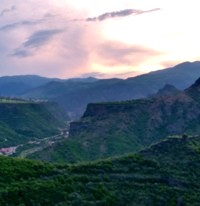
Then it was onwards and upwards to an Albanian Church in the village of Kish, again in a fleet of taxis as the street is steep and winding.  It's also described as an Albanian 'Temple' as the church is built over a pre-Christian temple. Construction of the existing Christian church building began around 990 and was completed around 1160 CE but the temple it was built over was much older. 

Radiocarbon dating of sacrificial objects found beneath the existing altar and in Bronze Age graves in the grounds revealed some to be around five thousand years old.  So the church is something of a time-capsule. Christianity was introduced here in the 1st century through St. Elisæus of Albania whose mission was to convert the polytheistic tribes. As I later discovered, among their observances, probably to appease to their angry earthquake and volcano generating gods, people here practiced human sacrifice (like Abraham - before his God, Yahweh, stopped him).  As I've noticed during our travels, human sacrifice seems to have been practiced in many earthquake zones and volcanic places - like other religious practices I suppose it works - until the next one.

Since Soviet times this site's been of considerable archaeological significance. Several Bronze Age graves found in the grounds are now opened, under glass, to reveal the skeletons of the ancient dead.


See album See album
See album See album

Albanian Church in the village of Kish
Radiocarbon dating of objects and graves found on the site revealed some to be around five thousand years old
There are more images in the Azerbaijan Album See more...


No comments

Travel

Malta


Almost everyone in Australia knows someone who hailed directly from Malta or is the child of Maltese parents. There are about a quarter as many Maltese Australians as there are Maltese Maltese so it is an interesting place to visit; where almost every cab driver or waiter announces that he or she has relatives in Sydney or Melbourne.

Read more: Malta

Fiction, Recollections & News

The Atomic Bomb according to ChatGPT


Introduction:

The other day, my regular interlocutors at our local shopping centre regaled me with a new question: "What is AI?" And that turned into a discussion about ChatGPT.

I had to confess that I'd never used it. So, I thought I would 'kill two birds with one stone' and ask ChatGPT, for material for an article for my website.

Since watching the movie Oppenheimer, reviewed elsewhere on this website, I've found myself, from time-to-time, musing about the development of the atomic bomb and it's profound impact on the modern world. 

Nuclear energy has provided a backdrop to my entire life. The first "atomic bombs" were dropped on Japan the month before I was born. Thus, the potential of nuclear energy was first revealed in an horrendous demonstration of mankind's greatest power since the harnessing of fire.

Very soon the atomic reactors, that had been necessary to accumulate sufficient plutonium for the first bombs, were adapted to peaceful use.  Yet, they forever carried the stigma of over a hundred thousand of innocent lives lost, many of them young children, at Hiroshima and Nagasaki.

The fear of world devastation followed, as the US and USSR faced-off with ever more powerful weapons of mass destruction.

The stigma and fear has been unfortunate, because, had we more enthusiastically embraced our new scientific knowledge and capabilities to harness this alternative to fire, the threat to the atmosphere now posed by an orgy of burning might have been mitigated.

Method:

So, for this article on the 'atomic bomb', I asked ChatGPT six questions about:

  1. The Manhattan Project; 
  2. Leo Szilard (the father of the nuclear chain reaction);
  3. Tube Alloys (the British bomb project);
  4. the Hanford site (plutonium production);
  5. uranium enrichment (diffusion and centrifugal); and
  6. the Soviet bomb project.

As ChatGPT takes around 20 seconds to write 1000 words and gives a remarkably different result each time, I asked it each question several times and chose selectively from the results.

This is what ChatGPT told me about 'the bomb':

Read more: The Atomic Bomb according to ChatGPT

Opinions and Philosophy

Population and Climate Change – An update


Climate


I originally wrote the paper, Issues Arising from the Greenhouse Hypothesis, in 1990 and do not see a need to revise it substantially.  Some of the science is better defined and there have been some minor changes in some of the projections; but otherwise little has changed.

In the Introduction to the 2006 update to that paper I wrote:

Climate change has wide ranging implications...  ranging from its impacts on agriculture (through drought, floods, water availability, land degradation and carbon credits) mining (by limiting markets for coal and minerals processing) manufacturing and transport (through energy costs) to property damage resulting from storms.

The issues are complex, ranging from disputes about the impact of human activities on global warming, to arguments about what should be done and the consequences of the various actions proposed.

Read more: Population and Climate Change – An update

Terms of Use

Terms of Use                                                                    Copyright