
Who is Online

We have 118 guests and no members online


Population growth


During the last 4,000 years or so the human population of the planet is thought to have been relatively stable at between a quarter and half a billion people.  For the preceding 70,000 years the population was considerably smaller.   Someone who believed in reincarnation could then reasonably believe the soul passed from one person to another as one died and another was born.  But in the last hundred years the population has grown exponentially.  There are now (2015) 7.3 billion people still alive and this number is likely to reach 11 billion before stabilising. 
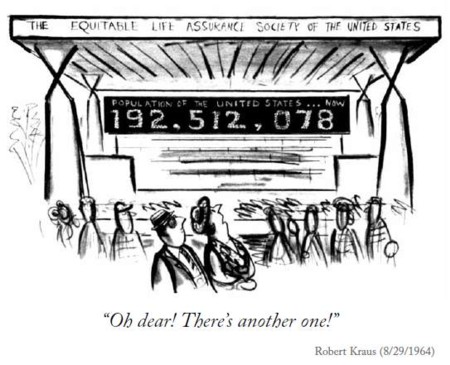
 

 another one
In this cartoon from 1964 the US population is shown as 192,512,078. By the end of 2015 this had risen to 322,354,800.


In 2015 there were an estimated 57 million deaths worldwide.  This equates to around 156 thousand a day.

Anthropologists now estimate that since modern humans emerged, between 90 and 110 billion of us are already dead. 

As God was rather tardy in sending his Son to save the sinners, the great majority of these people lived and died without the benefit or knowledge of Christian salvation.

But the book of Revelations suggests that at the day of judgement there will be 144,000 souls in heaven (Rev 7:4-8 ‘And I heard the number of those who were sealed, one hundred and forty-four thousand sealed from every tribe of the sons of Israel’).

This falls somewhat short of the 100 billion souls that God has reputedly handed out in the past and is exceeded every day by the present daily death rate.

While it says nothing about the possibility of an immortal soul of a Buddhist or eastern variety, it puts a fairly large hole in the orthodox Christian conception. 

Even if it was argued that only the purest, confessing Christians, are filtered from this large number for salvation, it suggests extremely poor-quality-control by God, who casts into oblivion thousands of millions of souls that He, somewhat frivolously created, before sending his son to redeem them, to say nothing of sincere believers in other religions. 

But then, the book of Revelations is regarded as apocryphal by the Eastern Church and many theologians. 


No comments

Travel

Istanbul


Or coming down to earth...


When I was a boy, Turkey was mysterious and exotic place to me. They were not Christians there; they ate strange food; and wore strange clothes. There was something called a ‘bazaar’ where white women were kidnapped and sold into white slavery. Bob Hope and Bing Crosby, or was it Errol Flynn, got into all sorts of trouble there with blood thirsty men with curved swords. There was a song on the radio that reminded me over and over again that ‘It’s Istanbul not Constantinople Now’, sung by The Four Lads, possibly the first ‘boy band’.


Read more: Istanbul

Fiction, Recollections & News

The Atomic Bomb according to ChatGPT


Introduction:

The other day, my regular interlocutors at our local shopping centre regaled me with a new question: "What is AI?" And that turned into a discussion about ChatGPT.

I had to confess that I'd never used it. So, I thought I would 'kill two birds with one stone' and ask ChatGPT, for material for an article for my website.

Since watching the movie Oppenheimer, reviewed elsewhere on this website, I've found myself, from time-to-time, musing about the development of the atomic bomb and it's profound impact on the modern world. 

Nuclear energy has provided a backdrop to my entire life. The first "atomic bombs" were dropped on Japan the month before I was born. Thus, the potential of nuclear energy was first revealed in an horrendous demonstration of mankind's greatest power since the harnessing of fire.

Very soon the atomic reactors, that had been necessary to accumulate sufficient plutonium for the first bombs, were adapted to peaceful use.  Yet, they forever carried the stigma of over a hundred thousand of innocent lives lost, many of them young children, at Hiroshima and Nagasaki.

The fear of world devastation followed, as the US and USSR faced-off with ever more powerful weapons of mass destruction.

The stigma and fear has been unfortunate, because, had we more enthusiastically embraced our new scientific knowledge and capabilities to harness this alternative to fire, the threat to the atmosphere now posed by an orgy of burning might have been mitigated.

Method:

So, for this article on the 'atomic bomb', I asked ChatGPT six questions about:

  1. The Manhattan Project; 
  2. Leo Szilard (the father of the nuclear chain reaction);
  3. Tube Alloys (the British bomb project);
  4. the Hanford site (plutonium production);
  5. uranium enrichment (diffusion and centrifugal); and
  6. the Soviet bomb project.

As ChatGPT takes around 20 seconds to write 1000 words and gives a remarkably different result each time, I asked it each question several times and chose selectively from the results.

This is what ChatGPT told me about 'the bomb':

Read more: The Atomic Bomb according to ChatGPT

Opinions and Philosophy

Manufacturing in Australia


This article was written in August 2011 after a career of many years concerned with Business Development in New South Wales Australia. I've not replaced it because, while the detailed economic parameters have changed, the underlying economic arguments remain the same (and it was a lot of work that I don't wish to repeat) for example:  

  • between Oct 2010 and April 2013 the Australian dollar exceeded the value of the US dollar and that was seriously impacting local manufacturing, particularly exporters;
  • as a result, in November 2011, the RBA (Reserve Bank of Australia) reduced the cash rate (%) from 4.75 to 4.5 and a month later to 4.25; yet
  • the dollar stayed stubbornly high until 2015, mainly due to a favourable balance of trade in commodities and to Australia's attraction to foreign investors following the Global Financial Crisis, that Australia had largely avoided.


2011 introduction:

Manufacturing viability is back in the news.

The loss of manufacturing jobs in the steel industry has been a rallying point for unions and employers' groups. The trigger was the announcement of the closure of the No 6 blast furnace at the BlueScope plant at Port Kembla.  This furnace is well into its present campaign and would have eventually required a very costly reline to keep operating.  The company says the loss of export sales does not justify its continued operation. The  remaining No 5 blast furnace underwent a major reline in 2009.  The immediate impact of the closure will be a halving of iron production; and correspondingly of downstream steel manufacture. BlueScope will also close the aging strip-rolling facility at Western Port in Victoria, originally designed to meet the automotive demand in Victoria and South Australia.

800 jobs will go at Port Kembla, 200 at Western Port and another 400 from local contractors.  The other Australian steelmaker OneSteel has also recently announced a workforce reduction of 400 jobs.

This announcement has reignited the 20th Century free trade versus protectionist economic and political debate. Labor backbenchers and the Greens want a Parliamentary enquiry. The Prime Minister (Julia Gillard) reportedly initially agreed, then, perhaps smelling trouble, demurred. No doubt 'Sir Humphrey' lurks not far back in the shadows. 


So what has and hasn't changed (disregarding a world pandemic presently raging)?


Read more: Manufacturing in Australia

Terms of Use

Terms of Use                                                                    Copyright