
Communism
As a tourist it is easy to forget that China is a communist country where central planning is still very important. The government does not suffer opposition lightly. This is illustrated in the case of Rio Tinto where the Government took action to protect State owned businesses from industrial intelligence gathering; and possibly in retaliation for a failed business association.
Although there is a blossoming arts community, freedom of expression is still not tolerated in some areas. Among these is intolerance to some religions and sects like Falun Gong, a version of Buddhism that was believed by officials to be growing alarmingly and to be counter to scientific reality.
Similar strong action has been taken against the activities of the dissident Buddhists in Tibet, now an Autonomous Region within China, who support the Indian Dalai Lama and his ‘Tibetan government in exile’. In some ways this is understandable as it is well documented that the CIA were once very active in this region of China in support of the so called ‘government in exile’. There are few governments that would tolerate another government fermenting unrest and in any region inside their country.
In the lead-up to the Beijing Olympics, Buddhist and supporters of the Dalai Lama staged a demonstration; initially killing some 20 Han Chinese people and wounding many more; at locations both within and outside of the Tibetan Autonomous Region. These were clearly orchestrated attacks as there were simultaneous attacks on 18 Chinese embassies and consulates around the World. By the time the resulting rioting was over up to 80 people, including Buddhists, were reported dead.
As is typically the case when it comes to religion a schism has developed among Buddhists in respect of the unlikely way that the Panchen Lama is selected. The Chinese Buddhists support the ‘Eleventh Panchen Lama of Tibetan Buddhism’, Gyaincain Norbu. According to the Chinese, the traditional way is selecting the boy who is his reincarnation is by ‘drawing a name from the Golden Urn’; as opposed to the Dalai Lama’s method: the ‘recognition by the friends of his former incarnation’. Neither the Chinese nor the Tibetan exiles recognize each other's selection for the Panchen Lama. Both assume that there is such a thing as reincarnation. Like most such schisms, it seems to be a good excuse for killing people.
In July violent riots broke out in Ürümqi, the capital city of the Xinjiang Uyghur Autonomous Region in north-western China. The riots began when Uyghurs attacked Han Chinese and the Han retaliated. The riots had to be put down by the army in support of the local police. At least 197 people died with nearly 2,000 injured. Again a religion and ethnicity were at the heart of these riots. But unlike Tibet where Buddhism and the Dalai Lama have the following in the West; the Uyghurs are Muslims and the troubles were seen in the context of Muslim terrorism.
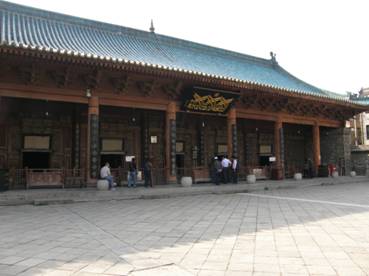 Prayer Hall Xi'an Mosque
One of the prominent leaders had alleged links to the ‘East Turkestan Islamic Movement’, listed terrorist organisation by the United Nations. Predictably, the alleged heavy-handed suppression of the riots was of greatest concern in Islamic countries. Like other Western leaders, our Prime Minister Kevin Rudd diplomatically urged restraint to bring about a ‘peaceful settlement to this difficulty’.
On both occasions China took measures that would be unacceptable in the West; including excluding some journalists and shutting down mobile phones and the Internet. With over 1.34 billion people spread over a vast and ethnically diverse country, there is periodic unrest in China and the authorities are still often aggressive putting it down. Local corruption is often cited as one of the causes and there is a current drive to reduce or eliminate this corruption.