Who is Online

We have 72 guests and no members online


In Sicily we hired a Jeep to get from Palermo around the island.

I had my doubts about this steed. Our two big bags wouldn't fit in the boot. One had to be strapped in on the back seat - a bit disappointing.

At above 130, the speed limit, there's something odd about the steering – so much so that I stopped quite soon to check the tyre pressures. I was regretting my choice.

Reassured about the tyres we set off again.

On the plus side the fuel consumption seemed OK and the zoned climate control worked well.

After two days of me complaining about the odd steering we got to Toarmina.

On entering we discovered that there was no parking in the old town, with roads one car wide and unbelievable traffic snarls – cars and tourist coaches moving around each other like tiles in a puzzle. We wound up and up then down and down, when at last a big blue P appeared. Hooray! - maybe we could actually stop and get out and maybe get something to eat!

Down a narrow street we went. Then up a one-way ally. Mistake! Someone's driveway. Jeep's GPS is suggesting the way. Then suddenly we are on dirt - but still a named road on the GPS.We pass two old codgers who look surprised to see us but don't offer any warning.  More like sharing a sly grin. We are climbing upwards again. This time out of town in the countryside. The dirt road begins winding crazily between tall gum trees. But GPS insists that this' the way.  Now along the cliffside 2.5 metres of width, Bushes scraping the side. No way to turn around now. Then a potholed and eroded 30 degree incline appeared.  A car wrecking drop to one side. This is the back of nowhere but there is some kind of dwelling up ahead.  Even Jeep needs to take a run at it. I doubt my car could do this!

Thank goodness we have a Jeep.

Back on proper roads again we have completely by-passed the tourist road blocks.  We get out and admire the view.
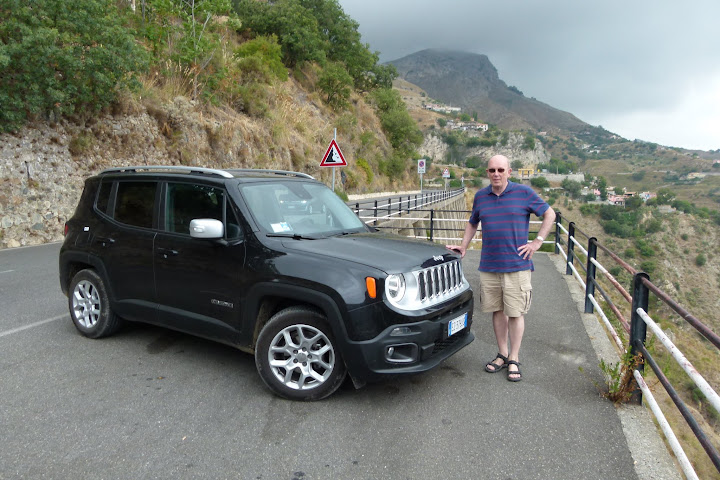
 

Jeep

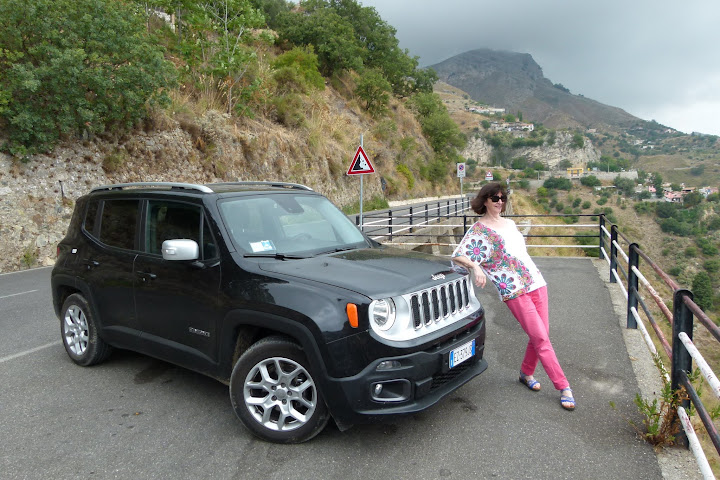
Wendy n Jeep


Still in one piece.  Shaken but not stirred. But Jeep is unconcerned.

As we recover it starts to pour - big rain drops. Spectacular lightening streaks in the distance.
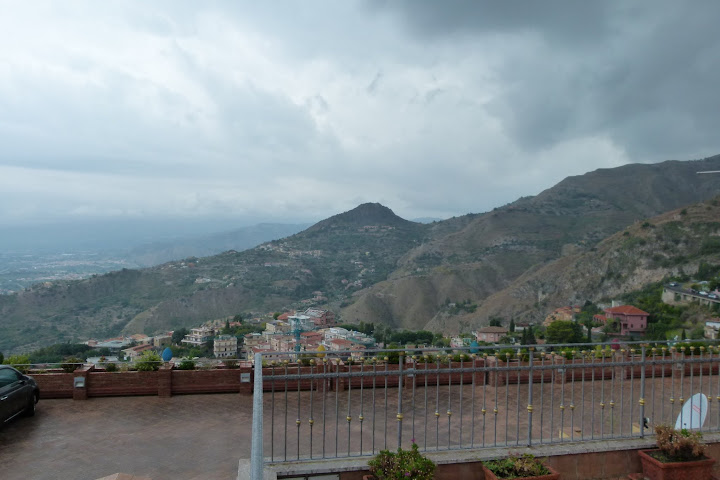
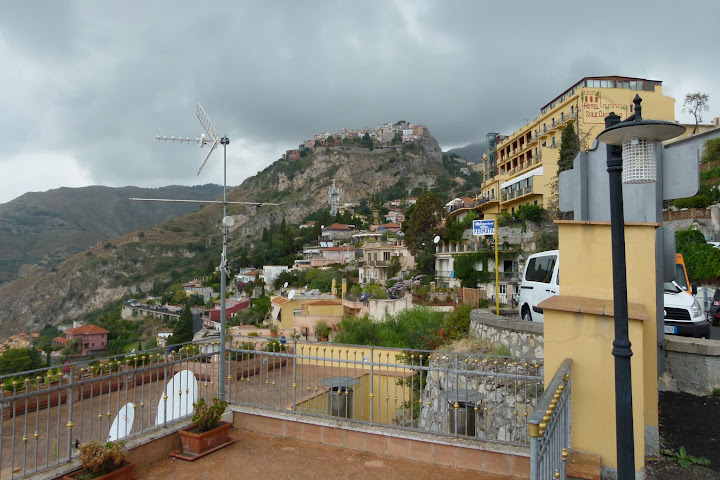


Storm aproaches

Town


On the slippy winding roads Jeep's traction control comes into play.

Now we're back on the expressway. The rain is getting heavier. Soon there is running water on the road and some big puddles. Now it's a shallow river. Cars ahead throw water high up to their sides.  So do we. Some slow to a crawl. Jeep doesn't mind. No need to slow below 100. No aquaplaning for us and the steering is rock solid. Jeep is teaching me a lesson. It's OK! I should never have doubted it.

Say sorry:  "Sorry!"


No comments

Travel

Balkans


In September 2019 we left Turkey by air, to continue our trip north along the Adriatic, in the Balkans, to Austria, with a brief side trip to Bratislava in Slovakia. 

'The Balkans' is a geo-political construct named after the Balkan Peninsula between the Adriatic and the Black Sea.

According to most geographers the 'Balkans' encompasses the modern countries of Albania; Bosnia and Herzegovina; Bulgaria; Croatia; Greece; Kosovo; Montenegro; North Macedonia; Serbia; and Slovenia. Some also include Romania. 

Read more: Balkans

Fiction, Recollections & News

More on 'herd immunity'


In my paper Love in the time of Coronavirus I suggested that an option for managing Covid-19 was to sequester the vulnerable in isolation and allow the remainder of the population to achieve 'Natural Herd Immunity'.

Both the UK and Sweden announced that this was the strategy they preferred although the UK was soon equivocal.

The other option I suggested was isolation of every case with comprehensive contact tracing and testing; supported by closed borders to all but essential travellers and strict quarantine.   

New Zealand; South Korea; Taiwan; Vietnam and, with reservations, Australia opted for this course - along with several other countries, including China - accepting the economic and social costs involved in saving tens of thousands of lives as the lesser of two evils.  

Yet this is a gamble as these populations will remain totally vulnerable until a vaccine is available and distributed to sufficient people to confer 'Herd Immunity'.

In the event, every country in which the virus has taken hold has been obliged to implement some degree of social distancing to manage the number of deaths and has thus suffered the corresponding economic costs of jobs lost or suspended; rents unpaid; incomes lost; and as yet unquantified psychological injury.

Read more: More on 'herd immunity'

Opinions and Philosophy

Climate Emergency


emergency
/uh'merrjuhnsee, ee-/.
noun, plural emergencies.
1. an unforeseen occurrence; a sudden and urgent occasion for action.


Recent calls for action on climate change have taken to declaring that we are facing a 'Climate Emergency'.

This concerns me on a couple of levels.

The first seems obvious. There's nothing unforseen or sudden about our present predicament. 

My second concern is that 'emergency' implies something short lived.  It gives the impression that by 'fire fighting against carbon dioxide' or revolutionary action against governments, or commuters, activists can resolve the climate crisis and go back to 'normal' - whatever that is. Would it not be better to press for considered, incremental changes that might avoid the catastrophic collapse of civilisation and our collective 'human project' or at least give it a few more years sometime in the future?

Back in 1990, concluding my paper: Issues Arising from the Greenhouse Hypothesis I wrote:

We need to focus on the possible.

An appropriate response is to ensure that resource and transport efficiency is optimised and energy waste is reduced. Another is to explore less polluting energy sources. This needs to be explored more critically. Each so-called green power option should be carefully analysed for whole of life energy and greenhouse gas production, against the benchmark of present technology, before going beyond the demonstration or experimental stage.

Much more important are the cultural and technological changes needed to minimise World overpopulation. We desperately need to remove the socio-economic drivers to larger families, young motherhood and excessive personal consumption (from resource inefficiencies to long journeys to work).

Climate change may be inevitable. We should be working to climate “harden” the production of food, ensure that public infrastructure (roads, bridges, dams, hospitals, utilities and so) on are designed to accommodate change and that the places people live are not excessively vulnerable to drought, flood or storm. [I didn't mention fire]

Only by solving these problems will we have any hope of finding solutions to the other pressures human expansion is imposing on the planet. It is time to start looking for creative answers for NSW and Australia  now.


Read more: Climate Emergency

Terms of Use

Terms of Use                                                                    Copyright