
Who is Online

We have 101 guests and no members online

Culture

Bali is renowned for its unique temples that echo those in Cambodia but are generally on a smaller scale.  The small ones are very numerous.  One of the largest is set in extensive gardens and is adjacent to a royal palace in the Badung Regency.


Pura Taman Ayun Temple - 15 km North of Denpasar


This one was not terribly exciting on the day we visited, the main action being preparing little baskets for offerings, but at Tirta Empul Temple the following day there was a lot more colour and movement.

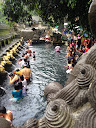
Tirta Empul Temple (Tirta Empul means Holy Spring in Balinese) is near the town of Tampaksiring. Here Balinese go to for ritual purification. The temple pond is fed by a spring, which delivers holy or amritha water. The occasional enthusiastic westerner gets in and gets purified too, even if they are not Hindu and have no idea what is going on.  It's like a Hindu lining up to receive the Eucharist in a Christian Church.  Some people assume it's OK for a westerner to join in with anything. 

In 1973 Brenda fell foul of the local dress rules one of the temples, despite having earlier returned to the cabin to put on a shirt after her bikini had been judged to be excessively revealing by someone on the boat. This seemed odd when venturing into a climate in which as little as possible seemed to be the most comfortable and sensible mode of dress.  As it turned out the shirt was superfluous and so was the bikini top.  The Balinese culture is accepting of bare breasts.  It's bare thighs that offend, presumably due to their sexual connotations.  Thighs should remain covered in public and particularly in a temple.  This was the first time that either of us had experienced a dramatically different culture or our unwitting propensity to offend. 

But nowadays skimpy beachwear and bare legs are everywhere in the tourist areas, so I suppose the locals have to look the other way.  I certainly found some of the tattoos remarkable.


Tirta Empul Temple (Puru Tirtha Empul) dedicated to Vishnu - pretty wet in or out.
The Villa on the hill overlooking the temple with the cool bridge was built for President Sukarno's visit in 1954
It's currently used as accommodation for important guests of the Government.


As I have said, in 1973 Bali looked like a paradise.  But I have since discovered that there is a royal family, descended from the Majapahit Empire that, despite having no constitutional role in the Indonesian version of democracy, still holds sway.  In 1965 the Hindu caste system was violently reinforced, as described below, so the caste system has continued to keep everyone in their place to this very day.

According to Wikipedia the four castes of Bali are:
  • Shudras – peasants making up more than 90% of Bali's population.
  • Wesias (Vaishyas) – the caste of merchants and administrative officials.
  • Ksatrias (Kshatriyas) – the warrior caste, it also includes some nobility and kings.
  • Brahmins – holy men and priests.


No comments

Travel

Darwin after Europe


On our return from Europe we spent a few days in Darwin and its surrounds.  We had a strong sense of re-engagement with Australia and found ourselves saying things like: 'isn't this nice'.

We were also able to catch up with some of our extended family. 

Julia's sister Anneke was there, working on the forthcoming Darwin Festival.  Wendy's cousin Gary and his partner Son live on an off-grid property, collecting their own water and solar electricity, about 120 km out of town. 

We went to the Mindl markets with Anneke and her friend Chris; and drove out to see Gary, in our hire-car, who showed us around Dundee Beach in his more robust vehicle. Son demonstrated her excellent cooking skills.


Read more: Darwin after Europe

Fiction, Recollections & News

Bonfire (Cracker) Night


We children were almost overcome with excitement.  There had been months of preparation.  Tree lopping and hedge trimmings had been saved; old newspapers and magazines stacked into fruit boxes; a couple of old tyres had been kept; and the long dangerously spiky lower fronds from the palm trees were neatly stacked; all in preparation. 

Read more: Bonfire (Cracker) Night

Opinions and Philosophy

Australia's $20 billion Climate strategy


We can sum this up in a word:

Hydrogen

According to 'Scotty from Marketing', and his mate 'Twiggy' Forrest, hydrogen is the, newly discovered panacea, to all our environmental woes:
 

The Hon Scott Morrison MP - Prime Minister of Australia

"Australia is on the pathway to net zero. Our goal is to get there as soon as we possibly can, through technology that enables and transforms our industries, not taxes that eliminate them and the jobs and livelihoods they support and create, especially in our regions.

For Australia, it is not a question of if or even by when for net zero, but importantly how.

That is why we are investing in priority new technology solutions, through our Technology Investment Roadmap initiative.

We are investing around $20 billion to achieve ambitious goals that will bring the cost of clean hydrogen, green steel, energy storage and carbon capture to commercial parity. We expect this to leverage more than $80 billion in investment in the decade ahead.

In Australia our ambition is to produce the cheapest clean hydrogen in the world, at $2 per kilogram Australian.

Mr President, in the United States you have the Silicon Valley. Here in Australia we are creating our own ‘Hydrogen Valleys’. Where we will transform our transport industries, our mining and resource sectors, our manufacturing, our fuel and energy production.

In Australia our journey to net zero is being led by world class pioneering Australian companies like Fortescue, led by Dr Andrew Forrest..."

From: Transcript, Remarks, Leaders Summit on Climate, 22 Apr 2021


Read more: Australia's $20 billion Climate strategy

Terms of Use

Terms of Use                                                                    Copyright