
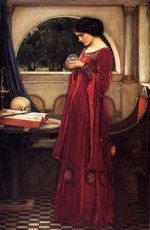
To test this further, I added some more details to my request to resemble more closely The Craft "write a fiction about Margery, a modern day witch who uses chemistry and female charms to enslave her familiars including Mohandas a software developer, a bishop and Phillip, a cosmetic surgeon". Unsurprisingly, ChatGPT changed the names accordingly and added some more detail.
Title: Margery's Enchantment: A Modern Witch's Tale
In the heart of a bustling city, where the pulse of life beat with the rhythm of urbanity, there dwelled a woman named Margery. To the world outside, she appeared as a mere mortal. With her long, flowing black hair, piercing green eyes, and an air of mysterious allure, she effortlessly enchanted those who crossed her path, her beauty and grace masking the depths of her secrets. But beneath her polished exterior lay a power that transcended the ordinary—a power born of ancient wisdom and modern science. Margery was a witch, wielding the arcane arts with the precision of a chemist and the allure of a siren.
Margery's journey into the realm of witchcraft began in her youth, where she discovered a natural affinity for the mysteries of magic. With a curious mind and a thirst for knowledge, she delved into the esoteric realms of alchemy and potion-making, blending ancient rituals with cutting-edge chemistry to create spells unlike any the world had ever seen.
But Margery's true strength lay not just in her mastery of the arcane, but in her ability to enchant those around her with her feminine charms. With a mere glance and a subtle smile, she could ensnare the hearts and minds of even the most steadfast souls, bending them to her will with effortless grace.
Among Margery's most devoted followers were her familiars—loyal companions bound to her through a potent combination of chemistry and charm. They were not mere servants but willing slaves, entranced by Margery's beauty and charisma, their minds clouded by the intoxicating allure of her spells.
One such familiar was Mohandas, a gifted software developer with a brilliant mind and a gentle soul. From the moment he met Margery, he was captivated by her ethereal beauty and magnetic presence, his thoughts consumed by desires he dared not voice. Little did he know, he was but a pawn in her intricate game—a puppet dancing to her tune, oblivious to the strings that bound him.
Margery's relationship with Mohandas was one of calculated manipulation and subtle coercion. Under the guise of mentorship and guidance, she slowly but surely ensnared him in her web of enchantment, his devotion to her growing with each passing day. With a whispered word and a gentle touch, she stoked the fires of his desire, bending him to her will with ease.
But Mohandas was not the only familiar under Margery's thrall. Among her other devoted followers was Bishop Alexander, a respected clergyman known for his unwavering faith and moral rectitude. Entranced by Margery's beauty and sophistication, Bishop Alexander found himself drawn into her orbit, his rational mind clouded by the allure of her charms.
Under Margery's guidance, Bishop Alexander became her most prized familiar, his influence in the community proving invaluable to her arcane experiments. Together, they delved into realms of magic and science, blurring the lines between the two until they became indistinguishable. With each passing day, Bishop Alexander fell deeper under Margery's spell, his thoughts consumed by thoughts of her and her alone.
But Margery's hold extended beyond the realm of spirituality. Among her familiars was Phillip, a talented cosmetic surgeon renowned for his skill and artistry. Entranced by Margery's beauty and sophistication, Phillip found himself drawn into her web of enchantment, his rational mind clouded by the allure of her charms.
Under Margery's guidance, Phillip became a prized familiar, his expertise in cosmetic surgery proving invaluable to her arcane experiments. Together, they delved into realms of magic and science, blending potions and incantations with surgical precision. With each passing day, Phillip fell deeper under Margery's spell, his thoughts consumed by thoughts of her and her alone.
But as Margery's power grew, so too did the whispers of dissent. Rumors spread like wildfire through the city, tales of a mysterious woman who wielded powers beyond mortal comprehension. Some whispered of witchcraft, while others dismissed it as mere fantasy. But beneath the surface, a storm was brewing—a storm that threatened to shatter Margery's carefully constructed facade.
Unbeknownst to Margery, there were those who sought to uncover the truth behind her enigmatic persona. Among them was Detective Emily Parker, a tenacious investigator with a keen eye for deception. Haunted by the memory of a loved one lost to the clutches of darkness, Emily was determined to expose Margery for what she truly was—a witch masquerading as a mere mortal.
As Emily delved deeper into Margery's past, she uncovered a web of intrigue and deceit that spanned generations. She traced Margery's lineage back to the Salem witch trials, where her ancestors had been accused of practicing black magic. But it was not just her bloodline that intrigued Emily—it was the strange occurrences that seemed to follow in her wake, the inexplicable accidents and disappearances that defied rational explanation.
Determined to unravel the mystery of Margery, Emily embarked on a perilous journey into the heart of darkness. With each step, she drew closer to the truth, uncovering secrets that threatened to tear apart the fabric of reality itself. But as she delved deeper, she realized that Margery's power was greater than she could have ever imagined—a force beyond the comprehension of mortal minds.
In a final confrontation that would decide the fate of them all, Emily confronted Margery in her opulent penthouse lair, armed with nothing but her wits and her determination. But Margery was not alone—she
was surrounded by her familiars, each bound to her will through the power of her charms. As Emily faced off against this formidable adversary, she knew that victory would come at a steep price—one that would test her resolve to its very limits.
In the end, it was not brute force or cunning that prevailed, but the power of love and sacrifice. For as Margery unleashed her darkest spells upon her, Emily refused to yield, her love for humanity guiding her through the shadows. With a final incantation, she broke the spell that bound Margery's familiars, freeing them from her thrall and restoring balance to the world.
As Margery's powers waned and her illusions crumbled, she realized the folly of her ambition—a quest for power that had consumed her soul and blinded her to the beauty of the world around her. In a moment of clarity, she renounced her dark arts, vowing to use her knowledge for the betterment of mankind.
And so, the tale of Margery came to an end—a cautionary tale of hubris and redemption, of the dangers of wielding power without wisdom. In the annals of history, she would be remembered not as a witch, but as a woman who dared to defy the boundaries of possibility and paid the price for her folly. And though her name would fade into obscurity, her legacy would endure—a testament to the enduring power of magic and the human spirit.